
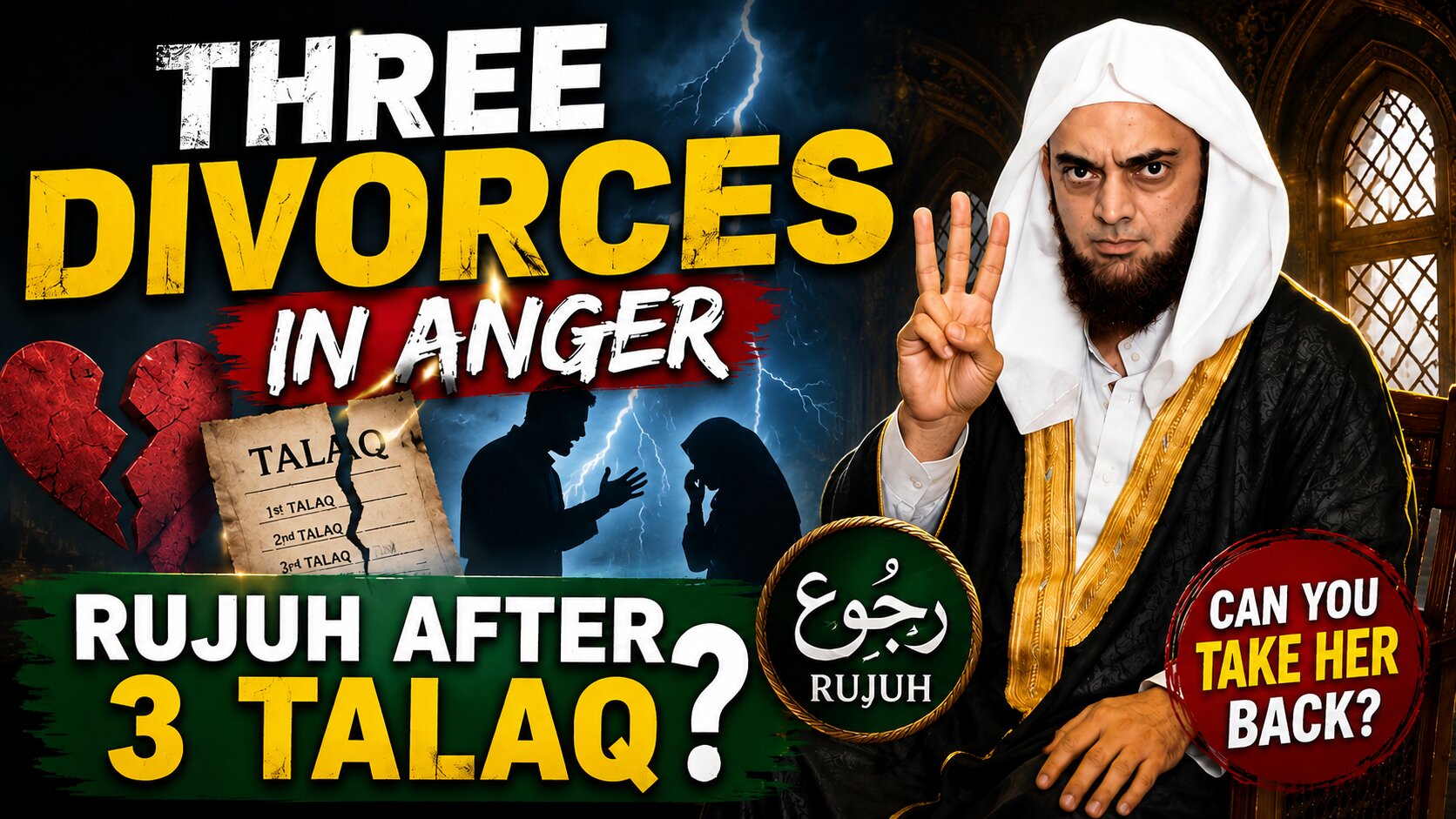
Three Talaq Given at Once. Is It Counted as One or Three?
Three Talaq Given at Once: Is It Counted as One or Three?
Divorce in Islam
Three Divorces in One Sitting: Does It Count as One or Three?
One of the most debated issues in Islamic family law is whether pronouncing three Talaqs at one time counts as three separate divorces or only one revocable divorce. According to the Salafi (Ahl al-Hadith) school of thought, supported by several early Companions, leading scholars, and the apparent evidence from the Qur’an and authentic Hadith, three Talaqs pronounced together in one sitting are counted as one revocable Talaq, not three.
This opinion is attributed to Ahadith of the Prophet ﷺ as well as Ahle Hadith/Salaf Muslim traditional scholars as Ibn Taymiyyah, Ibn al-Qayyim, Shaykh Ibn Baz, Shaykh Muhammad ibn Salih al-‘Uthaymin, Shaykh al-Albani, and many contemporary Salafi scholars. The fatwa of Talaq includes modern scholars follows that traditions of Hadith and Salaf.
Three Talaq According to Quran.
The Qur’an Prescribes Divorce in Stages
Allah says:
“Divorce is twice. Then, either retain her in an acceptable manner or release her with good treatment.”
Surah Al-Baqarah (2:229)
The verse establishes that divorce is meant to occur step by step, allowing opportunities for reconciliation after each revocable Talaq.
Allah further says:
“O Prophet! When you divorce women, divorce them for the commencement of their waiting period (‘Iddah) and keep count of the waiting period.”
Surah At-Talaq (65:1)
This verse indicates that divorce should follow the prescribed Islamic procedure and should not be rushed or combined into a single declaration.
Authentic Hadith: Three Talaqs Counted as One
The strongest evidence relied upon by Salafi scholars is the authentic narration of Ibn Abbas (رضي الله عنه).
Ibn Abbas reported:
“During the lifetime of the Messenger of Allah ﷺ, the time of Abu Bakr, and the first two years of the caliphate of Umar, three divorces pronounced together were counted as one. Then Umar ibn al-Khattab said: ‘People have begun rushing into a matter in which they used to proceed deliberately, so I will enforce it upon them.’ Thus he enforced it upon them.”
Reference:
- Sahih Muslim, Hadith 1472 (various numbering editions)
According to the Salafi understanding, this Hadith clearly demonstrates that the Prophet ﷺ regarded three Talaqs issued together as a single divorce.
Why Did Umar Count Them as Three?
Salafi scholars explain that the decision of Caliph Umar (رضي الله عنه) was an administrative policy (Ta’zir) introduced because people had begun abusing the divorce process.
It was intended as a disciplinary measure rather than a permanent change in the ruling established during the Prophet’s lifetime.
Therefore, according to this view, the original Sunnah remains that three Talaqs pronounced together count as one.
Another Hadith Supporting the View
Mahmud ibn Labid (رضي الله عنه) reported:
The Messenger of Allah ﷺ was informed about a man who divorced his wife by pronouncing three divorces together. The Prophet ﷺ became angry and said:
“Is the Book of Allah being toyed with while I am still among you?”
A man stood and said:
“O Messenger of Allah, shall I kill him?”
Reference:
- Sunan al-Nasa’i (3430)
Salafi scholars cite this narration to show that giving three Talaqs at once is an innovation (Bid’ah) and contrary to the prophetic method, even though they hold that it counts as one revocable divorce.
The Sunnah Method of Divorce
The Prophet ﷺ taught Muslims to divorce according to the Sunnah by:
- Pronouncing only one Talaq.
- Waiting during the wife’s ‘Iddah.
- Allowing reconciliation during the waiting period.
- If reconciliation fails, a second Talaq may be given at a later time.
- A third Talaq, if eventually issued after the prescribed stages, makes the divorce final.
This gradual process preserves opportunities for reflection and reconciliation.
Opinions of Salafi Scholars
Shaykh al-Islam Ibn Taymiyyah
Ibn Taymiyyah argued that three Talaqs pronounced together should be counted as one because this was the practice during the lifetime of the Prophet ﷺ and the early Caliphate.
Imam Ibn al-Qayyim
In Zad al-Ma’ad and I’lam al-Muwaqqi’in, Ibn al-Qayyim defended the position that triple Talaq in one sitting counts as one revocable divorce and discussed the evidence from the Qur’an and Sunnah.
Shaykh Abd al-Aziz ibn Baz
Shaykh Ibn Baz issued legal opinions stating that three Talaqs pronounced together count as one revocable Talaq according to the stronger evidence.
Shaykh Muhammad ibn Salih al-‘Uthaymin
Shaykh Ibn ‘Uthaymin likewise preferred the opinion that a triple pronouncement in one sitting counts as one divorce, based on the Hadith of Ibn Abbas and the objectives of the Shariah.
Shaykh Muhammad Nasir al-Din al-Albani
Shaykh al-Albani also regarded the Hadith of Ibn Abbas in Sahih Muslim as evidence that three Talaqs given together count as one.
Wisdom Behind This Ruling
The Salafi understanding emphasizes that Islam encourages reconciliation and discourages impulsive decisions. Counting an impulsive triple pronouncement as one revocable Talaq preserves the Qur’anic process of gradual divorce and gives families an opportunity to reconcile.
Important Note
This article presents the Salafi / Ahl al-Hadith position only, as requested. Other Sunni schools of jurisprudence have reached different legal conclusions on this issue. Readers should recognize that this is an area of legitimate scholarly disagreement (ikhtilaf), and those seeking a ruling for a specific case should consult a qualified scholar or mufti familiar with their circumstances.
Conclusion
According to the Salafi (Ahl al-Hadith) understanding, supported by the apparent meaning of the Qur’an and authentic narrations, three Talaqs pronounced at one time count as one revocable Talaq rather than three separate divorces. This view relies principally on the Hadith of Ibn Abbas in Sahih Muslim, together with the Qur’anic description of divorce as a staged process. While Caliph Umar (رضي الله عنه) later enforced triple pronouncements as three for disciplinary reasons, Salafi scholars maintain that the prophetic ruling remains the stronger evidence for ordinary legal application.
Frequently Asked Questions (FAQ)
Is three Talaq at once valid according to the Salafi view?
Yes. The pronouncement is considered sinful because it departs from the Sunnah method, but it counts as one revocable Talaq, not three.
Which Hadith states that three Talaqs count as one?
The primary evidence is the narration of Ibn Abbas in Sahih Muslim (Hadith 1472, numbering may vary by edition), stating that during the lifetime of the Prophet ﷺ, the caliphate of Abu Bakr, and the first two years of Umar’s caliphate, three divorces pronounced together were counted as one.
Does the Qur’an support gradual divorce?
Yes. Surah Al-Baqarah (2:229) describes divorce as occurring in stages (“Divorce is twice…”), and Surah At-Talaq (65:1) instructs believers to divorce according to the prescribed waiting periods, reflecting an orderly process rather than an instantaneous triple pronouncement.
Topics Covered
- Three Talaq counted as one
- Triple Talaq in Islam
- Three Talaq at once
- Salafi view on three Talaq
- Ahl al-Hadith three Talaq
- Triple Talaq according to Sunnah
- Sahih Muslim three Talaq
- Ibn Abbas Hadith on three Talaq
- Ibn Taymiyyah triple Talaq
- Ibn Baz three Talaq
- Ibn Uthaymin triple Talaq
- Albani three Talaq
- Qur’an on Talaq
- Islamic divorce according to Qur’an and Sunnah
- Talaq in Islam
- Revocable Talaq
- Islamic family law
- Triple Talaq evidence from Hadith
- Divorce in Islam according to Salafi scholars
- One Talaq or three Talaq at once