Islamic Divorce Khula Faskh Online
Islamic Divorce in USA & Canada: Khula and Faskh — How and Where to File
For Muslim women living in the USA or Canada, ending an Islamic marriage can involve two separate processes: civil/legal divorce and Islamic divorce. A civil divorce is handled through the appropriate court, while an Islamic divorce may be handled through a qualified Islamic scholar, Mufti, Shariah council, or Islamic family-law authority. Research on Islamic divorce in North America confirms that many Muslims pursue both processes because a religious divorce does not itself replace a civil divorce.
File Khula/Faskh
What Is Khula in Islam?
Khula (Khul’) is a form of Islamic divorce initiated by the wife. Depending on the circumstances and the applicable school of Islamic jurisprudence, the process may involve the husband’s agreement and issues concerning the mahr or other financial considerations. Islamic authorities may review the marriage circumstances and communicate with the husband before issuing a decision or Islamic divorce documentation.
What Is Faskh in Islam?
Faskh is the dissolution or annulment of an Islamic marriage by a qualified Islamic authority when there are recognized grounds for ending the marriage. It can be particularly important when a husband refuses to grant a divorce and the wife has legitimate grounds for seeking dissolution. Depending on the circumstances, grounds considered by Islamic authorities can include serious abuse, abandonment, failure to provide marital rights, or other circumstances that make continuation of the marriage untenable under applicable Islamic principles. A qualified scholar or Shariah authority should determine whether the requirements for faskh are met.
How and Where to File for Islamic Divorce in the USA or Canada
A Muslim woman seeking khula or faskh in the USA or Canada should first identify a qualified Islamic authority that handles Islamic marriage dissolution for women. The application commonly requires information such as the Nikah certificate or marriage contract, identification and contact information, details of the marriage, the reasons for requesting divorce, and supporting documentation when applicable.
The Islamic authority may review the application, contact the husband, attempt reconciliation where appropriate, investigate the circumstances, and then determine whether khula, faskh, or another form of Islamic dissolution applies.
It is important to understand that an Islamic divorce certificate is generally not the same as a civil divorce judgment. In Canada, a legal divorce must be obtained through the appropriate court, and the Canadian Department of Justice explains that divorce applications are filed according to the applicable provincial or territorial process. In the United States, civil divorce is likewise handled through the applicable state court system. Therefore, a woman may need both civil divorce proceedings and Islamic divorce proceedings.
Islamic Divorce Services for Muslim Women in USA & Canada
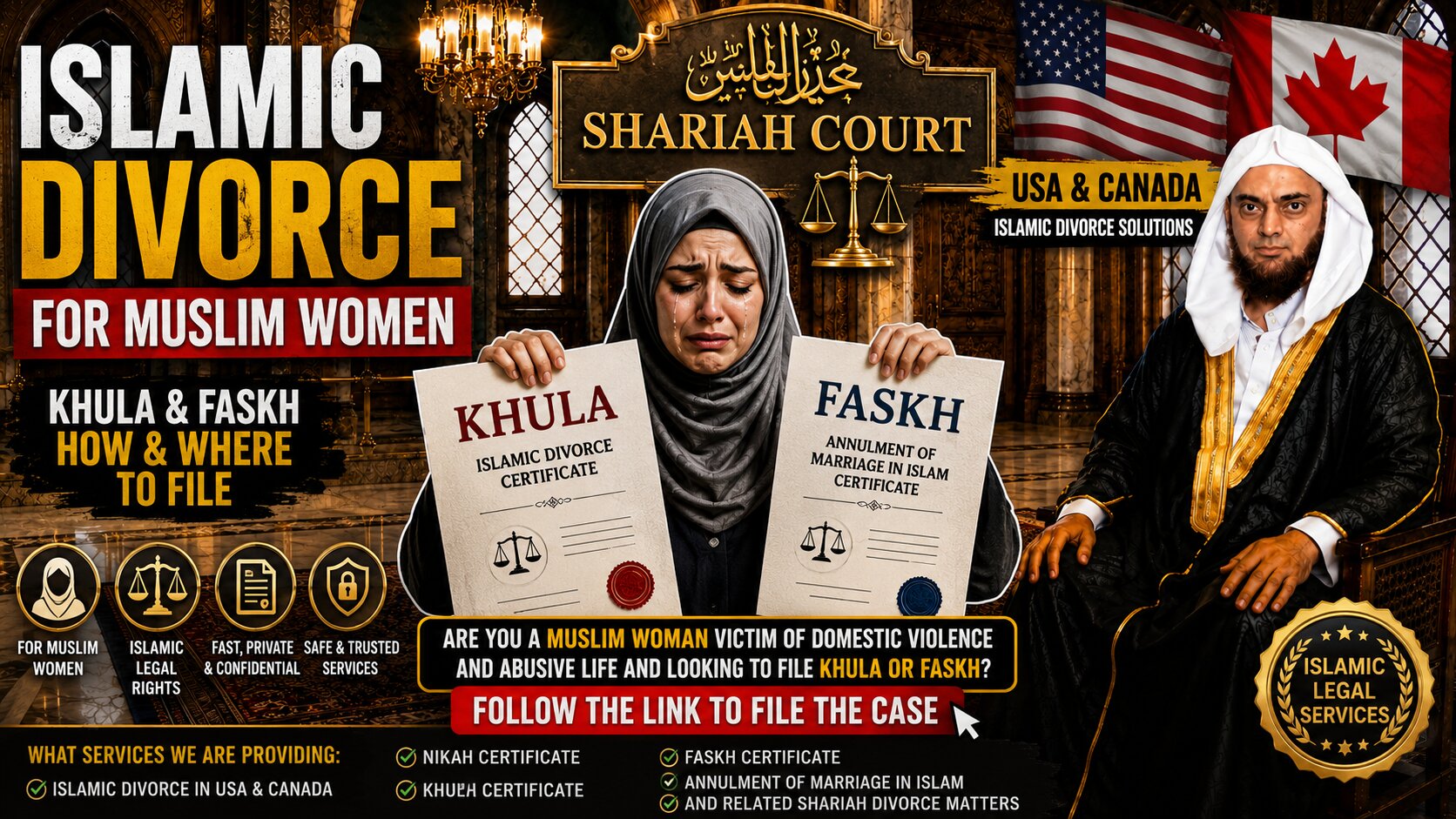
Are you a Muslim woman, a victim of domestic violence, living an abusive married life, and looking to file khula or faskh? You can seek an Islamic divorce through a qualified Shariah authority that reviews your circumstances and follows an appropriate Islamic procedure. Follow the link to file your Islamic divorce case and learn about the available process.
Our services include Islamic divorce in the USA and Canada, Nikah certificate assistance, Khula and Faskh applications, Khula certificate, Faskh certificate, annulment of marriage in Islam, Islamic marriage dissolution, Shariah divorce matters, Islamic divorce declarations, and related Islamic family-law services. The purpose is to provide Muslim women with a structured way to present their case to a qualified Islamic authority, particularly when they are unable to obtain a divorce directly from their husband.
If you are experiencing domestic violence or immediate danger, consider contacting appropriate local emergency, domestic-violence, legal, and support services in addition to seeking religious guidance. An Islamic divorce process does not replace legal protection or a civil divorce proceeding.