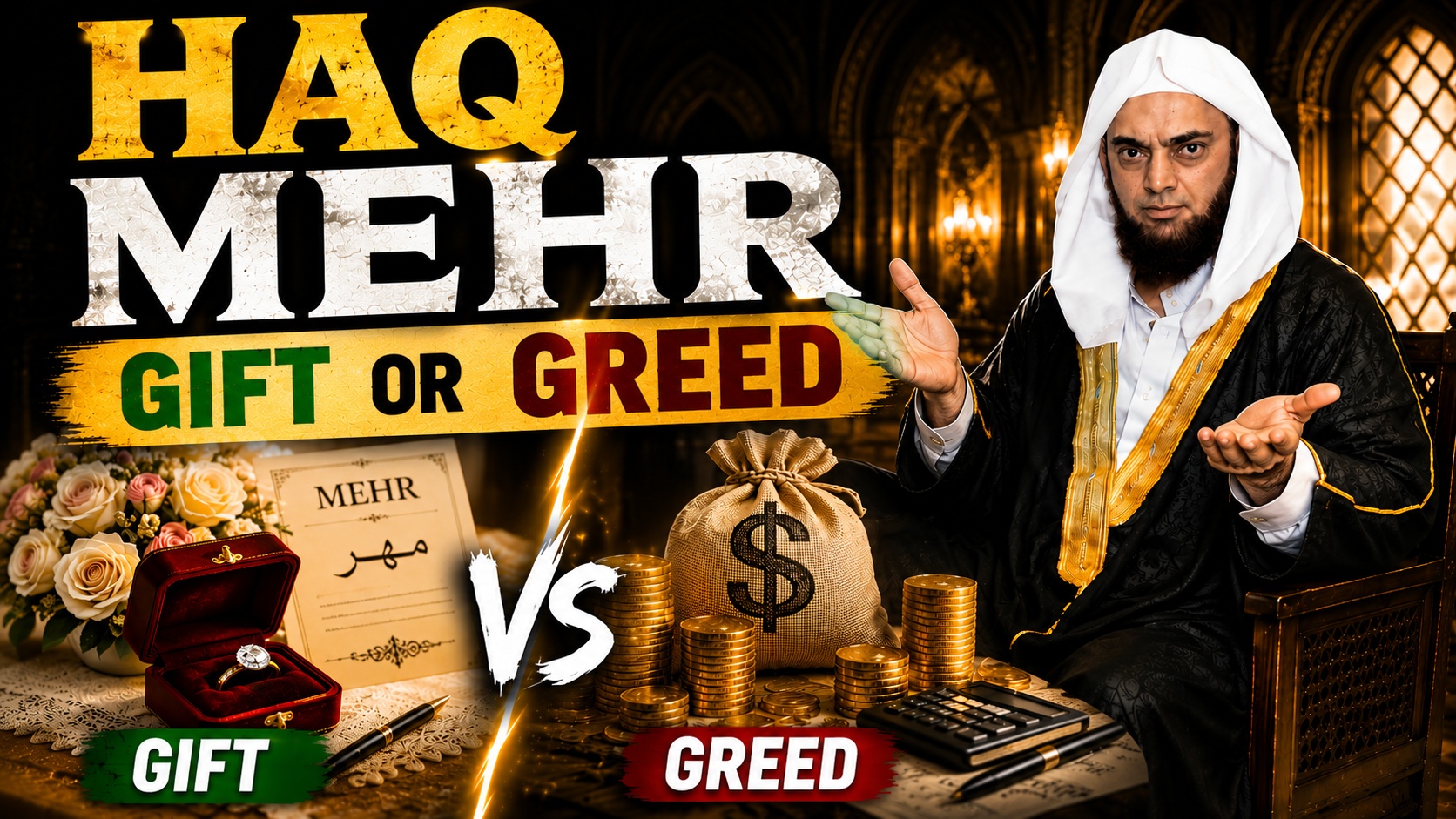
Haq Mehr Dowry Gift or Greed
Concept of Haq Mehr (Mahr): Dowry in Islam According to the Qur’an and Sunnah
Concept of Haq Mehr (Mahr) in Islam | Islamic Dowry Explained
Learn the Islamic concept of Haq Mehr (Mahr), its purpose, Qur’anic evidence, authentic Hadith, legal rulings, and common misconceptions about dowry in Islam.
Concept of Haq Mehr (Mahr): Dowry in Islam
The concept of Haq Mehr (Mahr) is one of the fundamental rights granted to a Muslim woman at the time of marriage. Unlike cultural dowry systems where the bride’s family is expected to provide wealth to the groom, Islam made Mahr an obligation upon the husband. Haq Mehr is a gift of honor, respect, and financial security that belongs exclusively to the wife.
Many people confuse Islamic Mahr with the cultural practice of dowry, but the two are entirely different. Islam abolished oppressive customs and established a system that protects the dignity and financial rights of women.
What is Haq Mehr (Mahr) in Islam?
Haq Mehr, also known as Mahr, Sadaq, or bridal gift, is the mandatory wealth, money, gold, property, or any lawful asset that a husband agrees to give his wife as part of the Nikah (marriage contract).
It is:
- An obligatory right of the wife.
- A condition of the marriage contract.
- The exclusive property of the wife.
- Not a payment for marriage.
- Not a purchase price of the bride.
- Not a dowry from the bride’s family.
Allah made Mahr a compulsory obligation upon every Muslim husband.
Qur’anic Evidence for Haq Mehr
Allah says:
“Give the women their bridal gifts (Mahr) graciously. But if they willingly remit any part of it to you, then consume it in satisfaction and ease.”
Surah An-Nisa (4:4)
This verse clearly establishes that Mahr belongs entirely to the wife and must be given willingly by the husband.
Allah also says:
“So for whatever you have enjoyed from them, give them their due compensation as an obligation.”
Surah An-Nisa (4:24)
These verses demonstrate that Mahr is a divine obligation and not merely a cultural tradition.
Authentic Hadith Regarding Mahr
The Prophet Muhammad ﷺ always encouraged simplicity in Mahr.
Sahl ibn Sa’d (رضي الله عنه) reported:
A man wished to marry a woman. The Prophet ﷺ asked him to give Mahr. The man replied that he possessed nothing. The Prophet ﷺ said:
“Search, even if it is only an iron ring.”
(Sahih al-Bukhari, Sahih Muslim)
This Hadith proves that there is no minimum amount fixed by Islam. Even a very small lawful gift fulfills the obligation if both parties agree.
Another narration states:
“The most blessed marriage is the one with the least burden (expense).”
(Reported in various Hadith collections with differing chains; the general principle of facilitating marriage is supported in authentic narrations.)
Is Haq Mehr the Same as Dowry?
No.
One of the biggest misconceptions is equating Haq Mehr with dowry.
| Islamic Haq Mehr (Mahr) | Cultural Dowry |
|---|---|
| Given by the husband | Often demanded from the bride’s family |
| Obligatory in Islam | Not required by Islam |
| Belongs entirely to the wife | Often benefits the groom or his family |
| A woman’s financial right | A cultural custom in many societies |
| Encouraged to be reasonable | Can become an oppressive financial burden |
Islam rejects the practice of demanding wealth, gifts, or money from the bride’s family as a condition of marriage.
Can Mahr Be Money, Gold, Property, or Anything Valuable?
Yes.
Islam allows Mahr to consist of anything lawful and agreed upon by both spouses, including:
- Cash
- Gold
- Silver
- Jewelry
- Land
- House
- Property
- Educational services
- Any lawful valuable asset
The important condition is that it is lawful, clearly specified, and accepted by both parties.
Who Owns the Mahr?
Once the Nikah is completed, the Mahr belongs exclusively to the wife.
Neither:
- Husband
- Father
- Mother
- Brother
- In-laws
have any right to take it without her free consent.
Allah says:
“But if they willingly remit any part of it to you, then take it in satisfaction.”
Surah An-Nisa (4:4)
This demonstrates that only the wife may choose to gift part or all of her Mahr back voluntarily.
Can Mahr Be Delayed?
Yes.
Islam permits:
- Immediate Mahr (Mu’ajjal)
- Deferred Mahr (Mu’akhkhar)
- A combination of both
If the deferred amount is agreed upon during the marriage contract, it becomes a debt owed by the husband until it is paid.
Is There a Minimum or Maximum Amount?
The Qur’an does not specify a minimum or maximum amount for Mahr.
Instead, Islamic teachings emphasize fairness, mutual agreement, and avoiding unnecessary hardship. Some jurists have discussed minimum amounts based on their legal methodologies, while others did not set a fixed minimum. Couples should consult qualified scholars if they have questions about the requirements in their legal school of thought.
Wisdom Behind Haq Mehr
Allah legislated Mahr to:
- Honor women.
- Demonstrate the husband’s commitment.
- Provide financial security.
- Protect the wife’s rights.
- Distinguish Islamic marriage from pre-Islamic customs.
- Promote justice within the marriage contract.
Common Misconceptions About Haq Mehr
Many misunderstandings exist regarding Mahr. In reality:
- Mahr is not the price of a woman.
- Mahr is not payment for marital relations.
- Mahr is not a gift to the bride’s parents.
- Mahr is not optional.
- Mahr is not the same as cultural dowry.
- Mahr should not be used as a tool to make marriage unnecessarily difficult.
Conclusion
Haq Mehr (Mahr) is one of the most important financial rights that Islam grants to women. The Qur’an and Sunnah establish it as a mandatory obligation upon the husband and an exclusive right of the wife. Islam distinguishes Mahr from cultural dowry practices and encourages marriages based on piety, justice, mutual respect, and reasonable financial expectations rather than social pressure or extravagance.
Islamic Family Law Services
If you are seeking guidance regarding Islamic marriage or divorce, we provide confidential Shariah-based services for Muslims in the United States and Canada, including:
- Islamic Divorce (Talaq)
- Khula
- Faskh (Judicial Dissolution)
- Islamic Annulment of Marriage
- Nikah Certificate
- Khula Certificate
- Faskh Certificate
- Islamic Divorce Certificate
- Verification of Civil Divorce under Islamic Law
- Guidance on Haq Mehr (Mahr) and marital rights
- General Shariah family law consultations
If you are a Muslim woman experiencing domestic violence, coercion, or an abusive marriage and are seeking Khula or Faskh, you may follow the appropriate case submission process through our services for confidential assistance in accordance with Islamic principles.
Frequently Asked Questions (FAQ)
Is Mahr compulsory in Islam?
Yes. Mahr is an obligation upon the husband and a right of the wife established in the Qur’an.
Does the bride’s family have to pay dowry in Islam?
No. Islam does not require the bride’s family to provide dowry to the groom.
Can Mahr be paid later?
Yes. Immediate, deferred, or partly deferred Mahr is permissible if agreed upon in the marriage contract.
Who owns the Mahr?
The wife alone owns her Mahr and has the exclusive right to use or keep it.
Can the husband reclaim the Mahr after divorce?
No, except in circumstances recognized under Islamic law and with the wife’s voluntary consent where applicable. The specific rules depend on the circumstances of the divorce.
Shariah Council of America
Haq Mehr in Islam, Mahr in Islam, Islamic Mahr, Islamic dowry, concept of Haq Mehr, Mahr meaning in Islam, Muslim marriage Mahr, Nikah Mahr, Islamic marriage gift.
Mahr according to the Qur’an, Mahr in Hadith, Islamic marriage contract, Muslim women’s rights in Islam, Surah An-Nisa Mahr, deferred Mahr, prompt Mahr, Islamic family law, Shariah marriage, Islamic Nikah rules, Haq Mehr USA, Islamic marriage services Canada.