
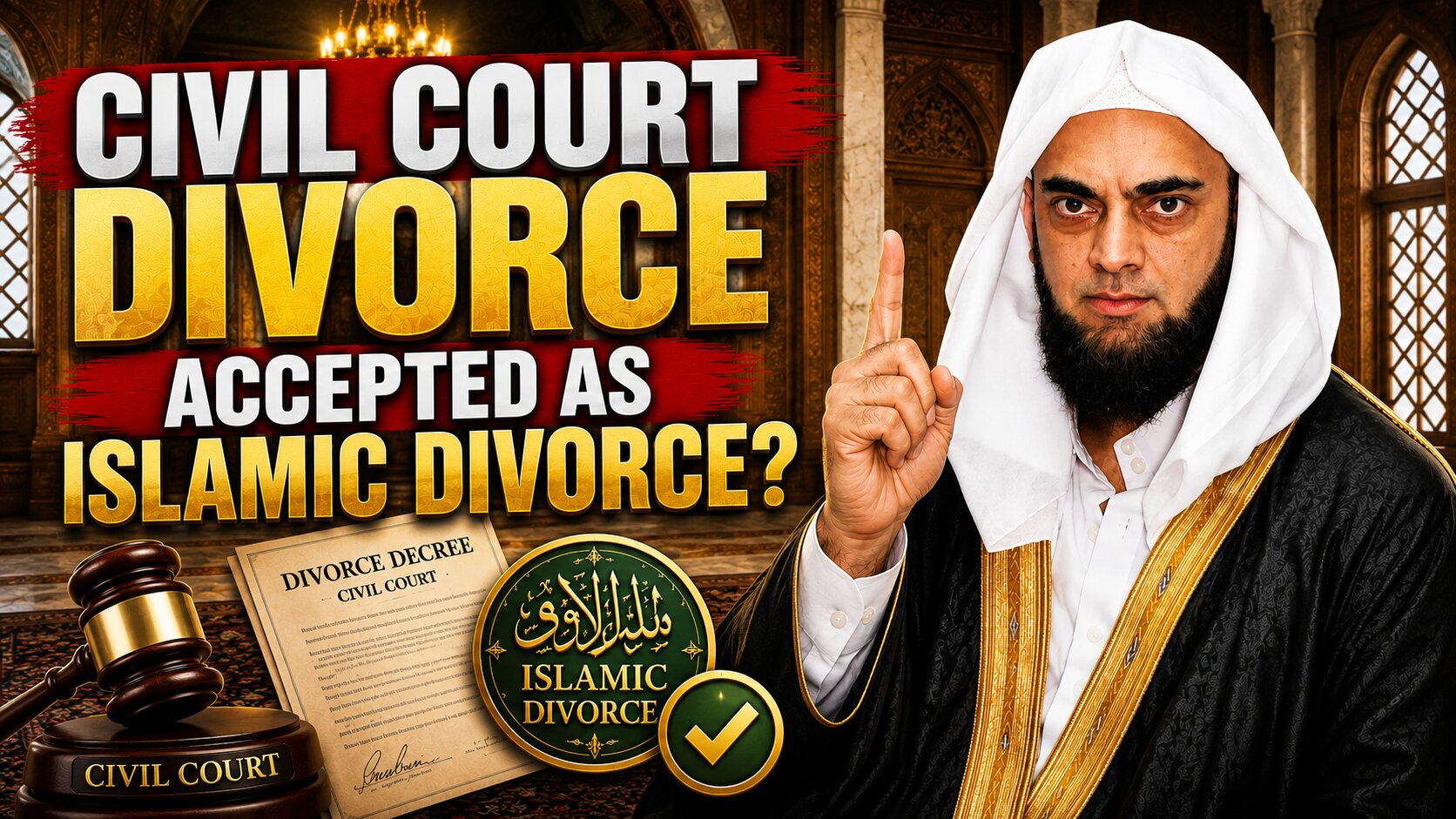
Civil Court Divorce and Islamic Divorce
Is a Civil Court Divorce in the West Accepted as an Islamic Divorce?
Is a Civil Court Divorce Recognized as an Islamic Divorce?
Many Muslims living in the United States, Canada, the United Kingdom, Australia, and Europe ask an important question: Is a civil court divorce in the West accepted as an Islamic divorce? The answer depends on the circumstances of the marriage, the method of divorce, the intention of the spouses, and the Islamic legal opinion (Madhhab) being followed.
Islamic scholars have discussed this issue extensively because Muslims living in non-Muslim countries often rely on civil courts to legally dissolve their marriages. While a civil divorce legally ends the marriage under the laws of the country, its recognition as an Islamic divorce (Talaq, Khula, or Faskh) depends upon whether the requirements of Shariah have also been fulfilled.
Are you looking to file Khula/ Faskh Contact us
FILE KHULA/FASKH
Does a Civil Court Divorce Automatically Count as an Islamic Divorce?
A civil court divorce does not automatically qualify as an Islamic divorce in every case. From an Islamic perspective, marriage (Nikah) is a religious contract governed by Shariah principles. Therefore, ending that marriage should also comply with Islamic rulings.
Several situations may arise:
- The husband intentionally issues Talaq during or before the civil divorce proceedings.
- The wife obtains a Khula through an Islamic authority.
- A qualified Islamic scholar or Shariah council grants a Faskh (judicial dissolution) when Islamic grounds exist.
- In certain situations, some contemporary scholars recognize a civil court judgment as fulfilling the role of an Islamic judicial dissolution when no Islamic court is available and the legal requirements under Shariah are satisfied.
Because every case is unique, a qualified Mufti or Islamic scholar should review the facts before determining whether the civil divorce also serves as a valid Islamic divorce.
What Do Islamic Scholars Say?
Contemporary scholars acknowledge that Muslims living in Western countries often lack access to official Islamic courts. For this reason, many scholars have developed legal opinions based on the principles of Islamic jurisprudence to address these situations.
Some scholars maintain that:
- A civil court divorce alone does not replace Talaq.
- A civil judgment may support an Islamic dissolution under certain conditions.
- If the husband refuses to grant an Islamic divorce while causing harm, abandonment, abuse, or neglect, an Islamic authority may issue Faskh after reviewing the evidence.
- Women seeking freedom from an abusive marriage may also apply for Khula, depending on the circumstances.
Since Islamic rulings differ according to the facts of each case, professional Islamic guidance is essential.
Why Is an Islamic Divorce Certificate Important?
Although a civil divorce legally ends the marriage in the country where you reside, many Muslims also require an Islamic Divorce Certificate for religious and practical purposes.
An Islamic divorce certificate may be needed for:
- Future Islamic marriage (Nikah)
- Proof of Islamic marital status
- Immigration or family documentation
- Mosque records
- Personal peace of mind
- Recognition within Muslim communities
Obtaining proper Islamic documentation helps avoid future disputes regarding marital status under Islamic law.
Civil Court Divorce and Different Types of Islamic Divorce
Depending on your circumstances, your case may involve one of the following Islamic procedures:
Talaq
If the husband pronounces a valid Talaq according to Islamic requirements, the marriage may be dissolved under Shariah while also being finalized through the civil court.
Khula
Khula is initiated by the wife when she seeks an Islamic divorce with appropriate Islamic procedures.
Faskh
Faskh is a judicial annulment granted by a qualified Islamic authority when sufficient Islamic grounds exist, such as abuse, abandonment, failure to provide maintenance, or other recognized causes.
Every Case Requires Individual Review
No two marriages are identical. Whether a civil court divorce is accepted as an Islamic divorce depends upon:
- The facts of the marriage
- The divorce process followed
- The intention of the spouses
- Applicable Islamic jurisprudence
- Supporting evidence
- The opinion of a qualified Islamic scholar or Mufti
Seeking qualified Islamic advice ensures that your divorce complies with both civil law and the requirements of Shariah.
Muslim Women Facing Domestic Violence, Abuse, or Harm
Are you a Muslim woman who is a victim of domestic violence, emotional abuse, abandonment, or an abusive marriage and looking to file Khula or Faskh? You may be eligible to apply for an Islamic dissolution of your marriage. Follow the appropriate application link on our website to begin your case.
Our Islamic Family Law Services Include:
- Islamic Divorce in the USA
- Islamic Divorce in Canada
- Khula Certificate
- Faskh Certificate
- Islamic Divorce Certificate
- Nikah Certificate
- Annulment of Marriage in Islam
- Shariah Divorce Consultation
- Islamic Marriage Dissolution
- Review of Civil Court Divorce under Islamic Law
- Islamic Family Law Guidance
- Muslim Marriage and Divorce Documentation
Our experienced team reviews each case individually according to the principles of Islamic jurisprudence while maintaining confidentiality, professionalism, and respect for every applicant.
We provide Information and Services
- Is civil court divorce accepted as Islamic divorce
- Civil court divorce in Islam
- Islamic divorce after civil divorce
- Does civil divorce count as Talaq
- Islamic divorce USA
- Islamic divorce Canada
- Shariah divorce in America
- Muslim divorce in Canada
- Islamic divorce certificate
- Khula online
- Apply for Khula
- Faskh application
- Faskh certificate
- Islamic annulment
- Annulment of marriage in Islam
- Muslim family law
- Islamic marriage dissolution
- Islamic Nikah certificate
- Talaq after civil divorce
- Civil divorce and Islamic law
- Islamic court divorce
- Shariah council divorce
- Muslim divorce services
- Islamic legal opinion on civil divorce
- Islamic divorce for domestic violence
- Islamic divorce for abused women
- Online Islamic divorce
- Islamic family law USA
- Islamic family law Canada
- Khula and Faskh services
- Islamic marriage annulment
- Islamic divorce consultation
- Muslim women divorce help
- Shariah-compliant divorce
- Islamic divorce process
- Recognition of civil divorce in Islam