
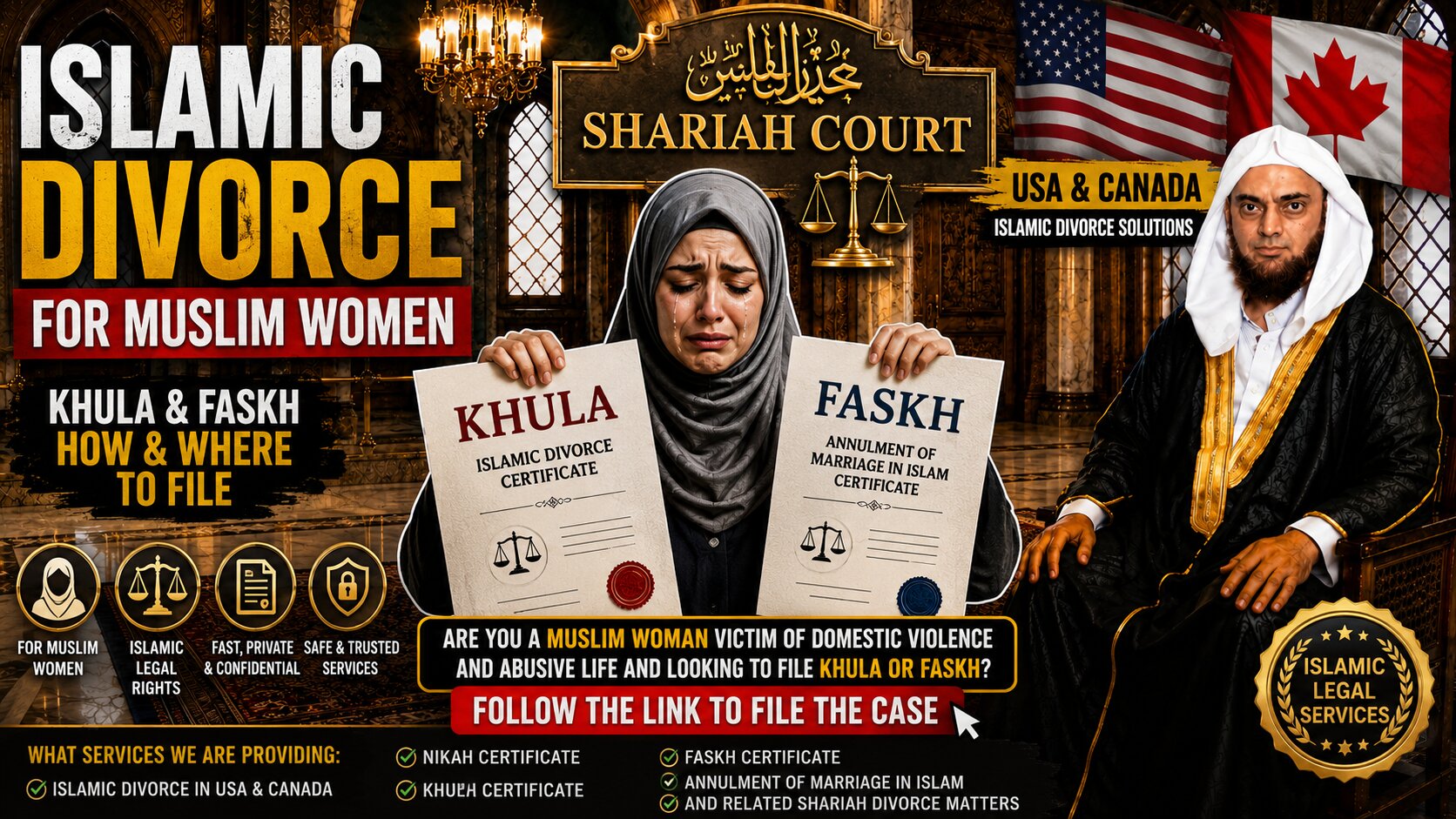
File Islamic Divorce Talaq Khula Faskh Annulment
Reasons to Consider Islamic Divorce (Talaq): When Is Divorce Permissible in Islam?
Marriage in Islam is a serious covenant built upon mutual respect, mercy, responsibility, and the rights of both spouses. Although Islamic divorce (Talaq) is permitted when a marriage can no longer continue properly, divorce should not normally be treated as the first solution to ordinary marital disagreements.
The Qur’an provides a structured approach to marital conflict, reconciliation, separation, and divorce. It also instructs spouses not to use divorce to cause harm or injustice.
For Muslims living in the United States and Canada, it is also important to understand the distinction between civil divorce and Islamic divorce (Talaq). A civil court proceeding may resolve legal marital status under the law of the country, while the Islamic status of a marriage can involve additional Shariah considerations.
The Islamic Perspective on Divorce and Talaq
Islam does not prohibit divorce. Talaq is an established form of Islamic divorce, but it should be approached carefully, responsibly, and according to Islamic principles.
A commonly quoted narration in Sunan Abi Dawud describes divorce as among the most disliked lawful matters. However, the narration is graded da’if (weak) by al-Albani, so it should not be presented as an authentic hadith without mentioning its grading.
The Qur’an emphasizes fairness even when a marriage ends. Allah instructs that when a marriage is being ended, the spouses should either retain the marriage honorably or separate honorably, and specifically prohibits retaining a wife with the intention of causing harm.
Therefore, the Islamic approach to divorce involves justice, careful consideration, reconciliation where appropriate, and protection from harm and abuse.
What Are Valid Reasons for Islamic Divorce?
There can be legitimate circumstances in which continuing a marriage becomes extremely difficult or harmful. The exact Islamic ruling depends upon the facts of each individual case, the evidence available, and the applicable principles of Islamic jurisprudence.
Examples of circumstances that may require consideration include:
1. Domestic Violence and Abuse
Physical violence, serious emotional abuse, threats, coercive behavior, and other forms of harmful treatment can become serious grounds for seeking Islamic marital relief.
A person experiencing domestic violence should prioritize immediate safety and seek appropriate professional, legal, and religious assistance.
2. Adultery or Sexual Immorality
Serious marital misconduct, including adultery, can fundamentally damage the trust and purpose of marriage. Depending on the circumstances, the affected spouse may have grounds to seek separation or another form of Islamic marital remedy.
3. Serious Dishonesty Before or During Marriage
Concealing significant information that materially affects the marriage may become an important consideration.
Examples can include deliberately concealing serious addictions, major marital conditions, or other circumstances that were relevant to the marriage contract.
4. Failure to Provide Financial Support
A husband’s inability or persistent refusal to fulfill his financial responsibilities toward his wife may be relevant when determining whether a marriage can continue.
5. Cruelty and Persistent Mistreatment
Continuous cruelty, severe mistreatment, humiliation, abandonment, or behavior that makes normal marital life impossible may require consideration by qualified Islamic authorities.
6. Serious Sexual or Marital Incompatibility
Certain circumstances involving the inability to fulfill marital rights or establish a normal marital relationship may require Islamic legal evaluation.
These matters should not be decided merely from a general internet article. A qualified scholar, mufti, or Shariah authority should examine the specific circumstances before determining the appropriate Islamic ruling.
Other Circumstances That May Require Islamic Legal Review
Depending on the circumstances and the school of Islamic jurisprudence being followed, issues that may require examination can include:
- Concealment of important information before marriage
- Serious addiction to alcohol or drugs
- Persistent cruelty or abuse
- Failure to provide obligatory financial maintenance
- Abandonment of the spouse
- Serious marital misconduct
- Inability to fulfill essential marital rights
- Certain serious defects or conditions affecting the marriage
- Religious differences arising after marriage
- Persistent conflict in which reconciliation has failed
- Circumstances in which continuing the marriage causes substantial harm
Every divorce case is individual. A general rule cannot automatically be applied to every husband or wife. The facts, evidence, marriage circumstances, and applicable Islamic legal principles should be carefully examined.
Divorce Should Not Be Based on Every Marital Disagreement
Not every disagreement is a reason for Talaq or Islamic divorce.
Marriage naturally involves differences in personality, habits, expectations, communication, and preferences. Disliking a spouse’s cooking, clothing, personality trait, or occasional moodiness does not automatically mean that divorce is necessary.
Islam encourages spouses to deal with ordinary disagreements through patience, communication, forgiveness, and reconciliation when reconciliation remains realistic and safe.
At the same time, reconciliation should not be used to pressure someone to remain in an abusive or dangerous relationship.
What Does the Qur’an Say About Resolving Marital Conflict?
The Qur’an provides a process for serious marital conflict. In Surah An-Nisa 4:35, it describes appointing representatives from both families when there is fear of a breakdown between husband and wife.
This demonstrates the importance of attempting appropriate reconciliation before separation when doing so is practical and safe.
However, where serious abuse, danger, or other circumstances exist, seeking qualified assistance and ensuring personal safety should take priority.
What Can Couples Do Before Divorce?
If the marriage is experiencing ordinary conflict and there is still a realistic possibility of reconciliation, couples may consider the following steps:
1. Remember Allah and the Responsibilities of Marriage
Both spouses should remember their accountability before Allah and avoid injustice, oppression, insults, and deliberate harm.
2. Communicate Clearly
Many marital problems become worse because spouses stop communicating. Calmly discussing the underlying problem can sometimes prevent unnecessary escalation.
3. Involve Trusted Family Members
For serious marital disputes, responsible family members may help both spouses communicate and explore possible solutions.
4. Consult a Qualified Imam or Islamic Scholar
A trustworthy and qualified Islamic scholar can help explain the relevant Islamic principles and distinguish between ordinary marital disagreements and circumstances that may justify separation.
5. Consider Professional Counseling
Marriage counseling may help when communication, emotional conflict, or relationship problems can realistically be addressed. Muslim couples may also consider a counselor who understands both marital dynamics and Islamic values.
6. Do Not Delay Action in Cases of Serious Abuse
Where domestic violence or serious danger is involved, the priority should be safety and protection from harm. Counseling or reconciliation should not be used to place a victim back into an unsafe situation.
Islamic Divorce, Talaq, Khula, Faskh and Civil Divorce
It is important to understand that Talaq, Khula, Faskh, and civil divorce are not necessarily the same procedure.
- Talaq generally refers to divorce initiated by the husband.
- Khula is a form of marital separation sought by the wife under Islamic law, subject to its applicable conditions and procedure.
- Faskh refers to judicial or authoritative annulment/dissolution of a marriage under recognized Islamic legal grounds.
- Civil divorce is the legal dissolution of a marriage under the applicable country’s civil law.
The correct procedure depends upon the circumstances of the marriage and the jurisdiction involved.
Conclusion: When Should a Muslim Consider Divorce?
Islamic divorce should be approached seriously and responsibly. A couple should not rush toward Talaq merely because of temporary disagreements, personality differences, or ordinary marital difficulties.
However, when there is domestic violence, serious abuse, abandonment, persistent failure to fulfill marital responsibilities, serious misconduct, or other circumstances that make continuation of the marriage harmful or impossible, the affected spouse may need to seek qualified Islamic guidance regarding Talaq, Khula, Faskh, or another appropriate Islamic remedy.
The Qur’an emphasizes that separation should be handled with justice and without causing harm.
Need Islamic Divorce Guidance in the USA or Canada?
If you are a Muslim woman experiencing domestic violence, an abusive marriage, abandonment, or serious marital problems, and you are looking for information about Khula or Faskh (Islamic annulment), seek qualified Islamic guidance about your individual circumstances.
You may also wish to learn about services relating to Islamic divorce in the USA and Canada, Talaq, Khula, Faskh, Islamic annulment, Nikah certificates, Khula certificates, Faskh certificates, and other Shariah marriage and divorce matters.
For case-specific guidance, provide the relevant marriage and marital circumstances to a qualified Shariah authority so that the appropriate Islamic procedure can be determined.
Islamic Divorce (Talaq) — Shariah Council US
Islamic Duvorce Services
Islamic divorce, divorce in Islam, Talaq in Islam, Islamic Talaq, reasons for divorce in Islam, valid reasons for Talaq, Muslim divorce, Islamic divorce USA, Islamic divorce Canada, Shariah divorce USA, Shariah divorce Canada, Khula, Faskh, Islamic annulment, Muslim woman divorce, Islamic annulment USA, Islamic annulment Canada, domestic violence Muslim marriage, abusive Muslim husband, Muslim marriage problems, Islamic divorce procedure, Shariah Council USA, Nikah certificate, Khula certificate, Faskh certificate.